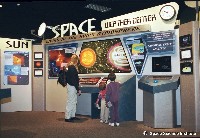
To introduce the public to space weather, the Challenger Space Center is currently hosting a traveling science exhibition called the Space Weather Center. The exhibit uses interactive components for hands-on learning; interesting graphics; and video displays to explore the Sun-Earth connection. The Space Weather Center also demonstrates how scientists use a variety of tools, including satellites, to forecast storms in our near-space environment.
The Space Weather Center, developed by the Space Science Institute of Boulder, Colorado, will be on display at the Challenger Space Center through August 31, 2003. Access to the exhibit is free with general admission to the Center, which is $6 for adults and $4 for children and seniors. The Challenger Center is open to the public Monday through Friday, 9:00 a.m. to 4:00 p.m.; Saturdays from 10:00 a.m. to 4:00 p.m.; closed on Sundays. The Center is located at 21170 North 83rd Avenue, just off Loop 101 and the Union Hills exit. Information: 623-322-2001.
Why learn about Space Weather? The weather outside your window may be sunny and mild while a space storm batters Earth’s near-space environment. Space storms can harm astronauts, damage satellites, disrupt telecommunications, and cause power grids to fail. What is a space storm? From time to time, clouds of electrified gas (or plasma) explode from the Sun and hurtle through space, sometimes reaching speeds of 2,000 kilometers per second. These solar eruptions are called coronal mass ejections (CMEs). When a CME approaches our planet it can interact with Earth’s magnetic field and cause magnetic storms. But you won’t see dark clouds. Instead, if you live near one of the poles, you might see the colorful aurora lights arching over the horizon.
From Earth, CMEs appear as sunspots. Galileo observed them in 1610, but it would take over 300 years for scientists to begin to understand how sunspots can affect Earth and its near-space environment. In our technology-dependent society, the ability to predict which CMEs will reach us and when has become increasingly important.
The Space Science Institute of Boulder, Colorado, collaborated with NASA’s Goddard Space Flight Center to develop the Space Weather Center. Major funding was provided by NASA and the National Science Foundation.