Missions
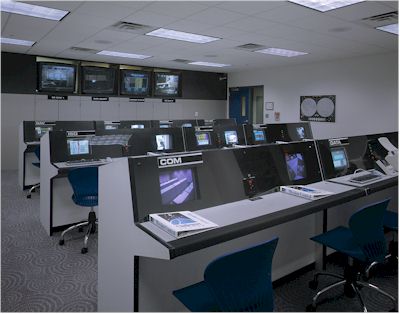 The Learning Center is
comprised of a "Spacecraft" which gives students a simulated
experience of working in space, and "Mission Control" which is
modeled after Mission Control at NASA’s Johnson Space Center in Houston,
Texas. The Learning Center presents tasks and poses realistic dilemmas
to develop problem-solving and communications skills. The experience
involves 16-32 active participants (students and teachers) in a two and
one half-hour mission.
The Learning Center is
comprised of a "Spacecraft" which gives students a simulated
experience of working in space, and "Mission Control" which is
modeled after Mission Control at NASA’s Johnson Space Center in Houston,
Texas. The Learning Center presents tasks and poses realistic dilemmas
to develop problem-solving and communications skills. The experience
involves 16-32 active participants (students and teachers) in a two and
one half-hour mission.
Classroom teachers are
required to participate in an 8-hour intensive pre-mission training
prior to visiting the Challenger Learning Center with their students.
During the pre-mission training, teachers experience the simulation
activities and review curriculum materials provided to them for use with
the students.
Supporting the educational
experience at each Learning Center are innovative curriculum materials
and computer software and hardware that guide the student crews on the
simulated space flight. These materials become integral elements of the
simulation. A Learning Center is capable of running different scenarios
each based on futuristic space missions.




"Rendezvous
with A Comet" simulates a rendezvous with Comet Encke as it
nears the Earth and involves launching a space probe into the comet’s
tail. (Available Now!)
"Return
to the Moon" simulates a lunar landing mission and the
colonization of the moon. (Available 2001)
"Voyage
to Mars" simulates a supply and relief mission as the crew
conducts its second visit to the planet Mars and also performs
scientific experiments in the spacecraft. (Available 2002)
"Encounter
Earth" creates an increased awareness of globalism and the
connection between human activity and ecological problems. It draws from
NASA’s 1992 Mission to Planet Earth Initiative. (Available 2003)
Flight Crew / Team
Members
From the Operations Deck
of the Space Station to the rows of monitors at Mission Control,
teamwork is essential for the student-crew. Upon arrival at the center,
students become mission specialists, serving on one of eight of the
following teams critical to the success of the mission:
|
The Communication
Team maintains audio link between Space Station and Mission
Control.
|
|
|
|
The Data Team
transmits diagrams and vital information between Mission Control
and the Space Station via computer terminal data link.
|
|
The Medical Team
uses computers to gather data relating to the crew’s general
health and reaction to the stress of the mission.
|
|
|

|
The Life Support
Team monitors and repairs the Space Station’s critical water, air
and electrical systems.
|
|
The Probe Team
assembles a data-gathering scientific probe to intercept the comet
and relay data for analysis.
|
|
|

|
The Biosphere
Remote Team uses robots to collect specimens for examination in
the Glove Box Laboratory.
|
|
The Navigation
Team uses star charts to locate celestial objects in star fields,
triangulates and controls the lunar landing.
|

|
|
The Robotic Isolation Team uses robots to handle hazardous
chemicals, conduct tests and count meteoroid impacts.
|
Corporate
Missions
Mission Facilitators
International (MFI) blasts teams into outer space using the high tech
simulator at the Challenger Learning Center of AZ, and returns them to
Earth with improved teamwork skills and increased clarity and commitment
to their work-place missions. MFI has three distinct programs
designed to help your team get and stay on the same page. "A real
memorable experience that has had bottom-line results!" .To find
out about their programs visit their website at www.missionfacilitators.com
or call them directly at 480-513-4518.
Mini-missions
Corporations, youth clubs,
organizations and individuals may make arrangements for shortened
missions. One popular implementation is a parent-child mini-mission.
Evening sessions, summer camps and special occasions are planned
throughout the year, making Challenger a year-round place to be…
For additional
information please contact the CLC or use this form.
